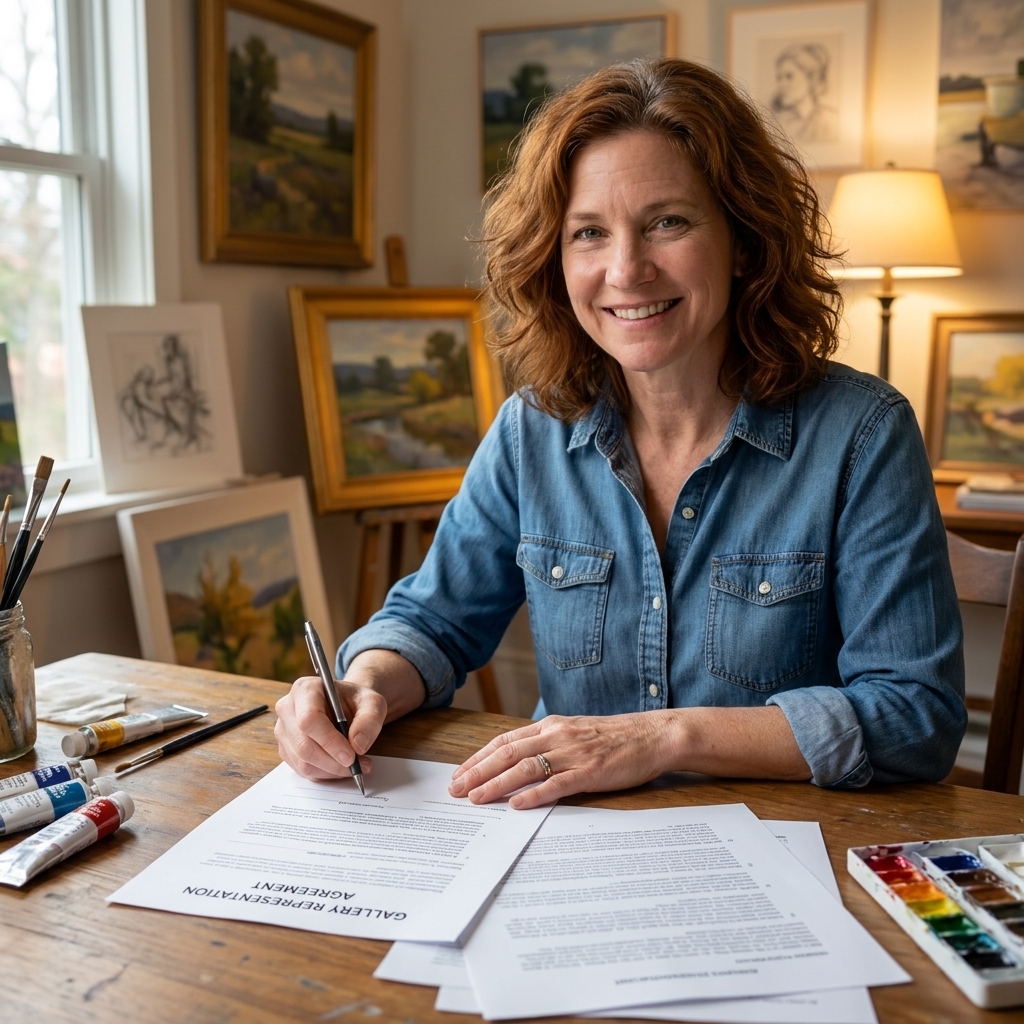
There is a particular kind of electricity that lives in a gallery the hour before opening. Fresh paint, still breathing lightly. Wall labels aligned like little stage marks. And an artist, quietly vibrating between pride and panic, wondering if they picked the right kind of show.
If you are an emerging fine artist, “solo vs. group” is not just a format choice. It is a strategic choice that touches everything: how collectors remember you, what it costs to produce the work, and whether you leave the opening night with three new contacts or thirty.
Let’s weigh it, plainly and without the velvet-rope mystique.

The quick difference (and why it matters)
A solo exhibition is one artist’s world. The story, the visual language, the risk, the rewards, and the pressure are concentrated on you.
A group exhibition is a chorus. Multiple artists share the room, the audience, and usually the promotional lift. You gain context and community, but you also share attention.
Neither is “better” in the abstract. The better choice is the one that matches your current body of work, your resources, and what you need next: clarity of voice, sales momentum, curatorial validation, or simply a wider net of connections.
Career benefits
Solo shows: a clean signal
A solo show tells curators and collectors something very specific: you have enough work, and enough coherence, to hold a room. That is not a small message. Even a modest solo exhibition can function like a calling card that says, “This artist has a point of view, and it sustains.”
- Stronger authorship. Viewers are less likely to confuse you with anyone else because the entire experience is anchored in your voice.
- Better documentation. Installation photos from a solo show are instantly legible for portfolios and grant applications. One aesthetic. One narrative. One name.
- Often easier to pitch. Many editors and outlets prefer to go deep on one artist rather than summarize ten quickly, though it depends on the publication and what else is happening that week.
The catch is that the solo show is also a referendum. If the work is uneven, thinly installed, or not yet fully resolved on the wall, the room will not politely look away.
Group shows: context and association
A strong group exhibition can do something magical for an early-career artist: it places your work in conversation. When the curatorial theme is thoughtful, you are not just “one more person on the roster.” You become part of an idea, a lineage, a moment.
- Borrowed audience. Each artist brings people. You get cross-pollination without having to build everything from scratch.
- Curatorial framing. If a respected curator or gallery organizes the show, their thesis can elevate how your work is read.
- Lower-stakes visibility. You can test how your work lands in public without the full weight of a solo debut.
The trade-off is dilution. People may remember “that show about memory and material” but not the title of your piece, unless you make it easy for them to remember you.
Financial reality
Exhibitions are not only aesthetic projects. They are logistical ones. Here is where solo vs. group becomes painfully tangible.
Solo shows: higher costs, more control
In a solo exhibition, you are responsible for filling the space in a way that feels intentional. That can mean:
- More work to produce (materials, studio time, fabrication, framing).
- Higher finishing costs (professional documentation, crating, shipping, installation help).
- More marketing expense if the venue expects you to handle invites, press outreach, or printed materials.
The upside is that your spending directly supports your own career assets: a deeper body of work, stronger images for your portfolio, and a more cohesive public presence.
Group shows: shared burden, hidden fees
Group exhibitions often feel cheaper, and they can be, especially when the gallery shoulders installation and promotion. But pay attention to the fine print.
- Participation fees. Some opportunities charge artists to exhibit. Sometimes this is legitimate cost recovery in an artist-run space. Sometimes it is a red flag. Ask where the money goes.
- Commission structures. If sales are split with the venue, confirm the percentage and who covers payment processing and shipping.
- Presentation requirements. Even one piece can become expensive if the show requires museum-grade framing, specific hanging hardware, or specialty pedestals.
If you are budgeting tightly, group shows can be a smart way to stay active and visible while you build towards a more ambitious solo project.

Sales and collectors
Solo shows: deeper attention, more pressure
Collectors often shop solo exhibitions differently. They come prepared to “meet” an artist, and many want to understand the arc of the work before purchasing. That can lead to:
- Sometimes, multiple-piece purchases from a single collector who wants a small grouping, not just one work.
- Clearer pricing logic when the work shares materials, scale, and conceptual footing.
- Cleaner follow-up. If someone is interested, there is no confusion about who to contact.
But if the opening is quiet or the audience is thin, it can feel like performing to an empty theater. The emotional cost is real, and newer artists feel it in their bones.
Group shows: more traffic, more browsing
Group shows can be lively. Families, friends, collectors, and curious walk-ins mingle because someone always knows someone. That energy can translate into sales, especially for:
- Smaller works that are easier to purchase on the spot.
- Editioned work like prints or photographs, if allowed.
- Work that reads fast in a crowded room and holds up close.
The risk is that your work becomes one part of a larger experience. If you do not have a clear visual signature or a short statement available, buyers may move on before they learn your name.
Networking
Solo shows: fewer talks, more depth
At a solo opening, you are the gravitational center. That can be exhausting, but it is also an unusually focused networking environment. When people come to talk to you, they typically want you, not just the party.
- Curators can assess depth. They see range, consistency, and ambition in one visit.
- Collectors can build trust. A longer conversation about your practice often leads to follow-ups.
- Stronger introductions. Gallerists are more likely to make meaningful connections when the event is centered on one artist.
Group shows: many contacts, faster and messier
Group exhibitions are social ecosystems. You meet other artists, their supporters, and sometimes new curators who are scouting broadly.
- Peer network grows quickly. This matters more than people admit. Your peers become your future collaborators and recommenders.
- More chances for serendipity. A collector might come for another artist and end up falling for your work.
- Shared promotion. Tagging, reposting, and co-hosting events can multiply reach.
The downside is that meaningful conversations can be harder to sustain. Openings can get loud, and attention flits. Plan a strategy: a short, warm “what I make and why” and a simple way to follow your work afterward.
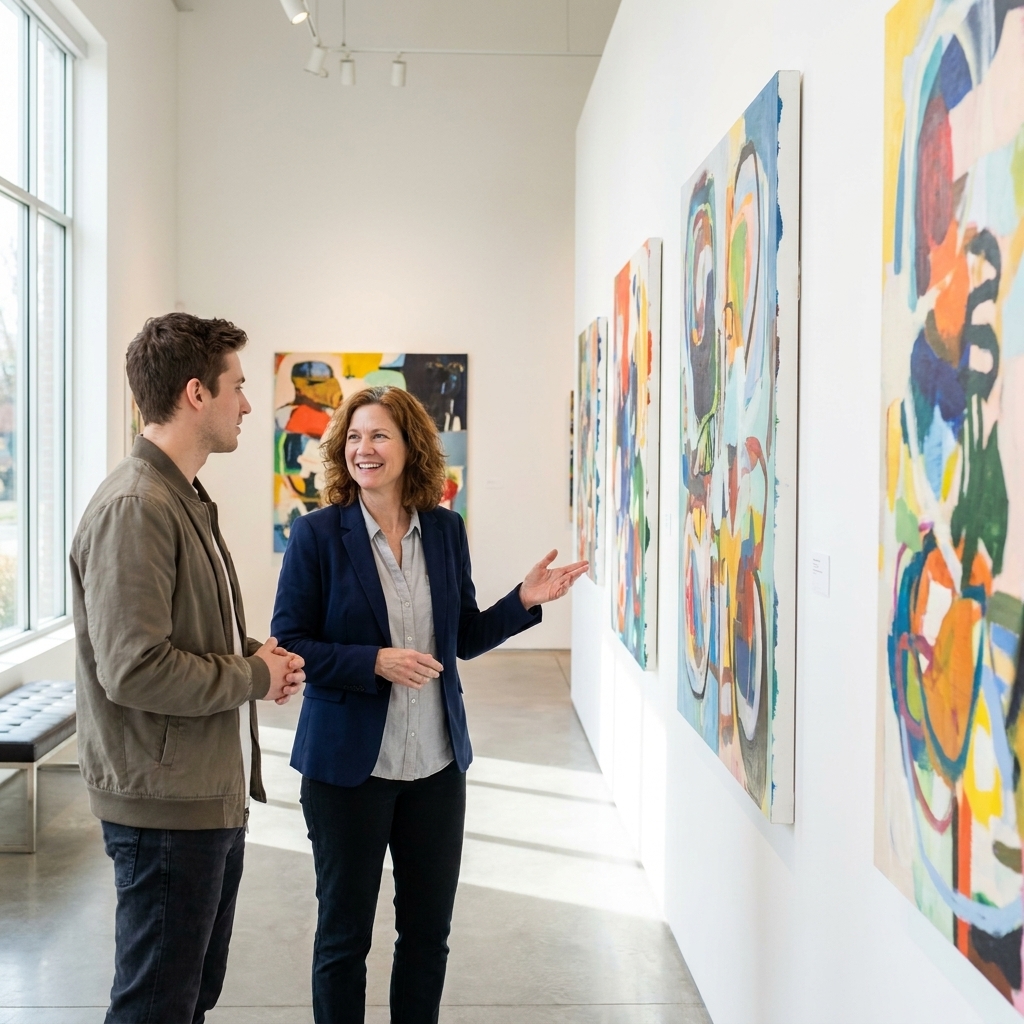
Which is better?
It depends on what you need next, and on the strength of the venue.
Choose a solo show if you have:
- A cohesive body of work (enough pieces that look like they belong to the same conversation).
- A clear thesis you can explain without over-defending it.
- Capacity for production, installation planning, and marketing follow-through.
- A venue that will truly support you (not just hand you the keys and wish you luck).
Choose a group show if you want:
- Lower financial risk while staying active and visible.
- New audiences fast through shared attendance and promotion.
- Curatorial context that helps people understand your work.
- Community with peers who are also building careers.
And yes, sometimes the smartest move is both: group shows to keep your work circulating, and a carefully timed solo show when your next series feels ready to take up space.
A decision checklist
If you are on the fence, ask yourself these questions and answer them honestly, not aspirationally.
1) Can I fill the room without repeating myself?
If you are padding a solo show with older work that no longer fits, consider a group show while you develop the next chapter.
2) Do I have a sales plan, not just hope?
Know your prices, edition details, framing status, and what happens after someone says, “I love it.” A solo show amplifies unpreparedness.
3) Is the venue doing real promotion?
Ask what they will do: press outreach, email list, social posts, VIP previews, collector calls. “We’ll share on Instagram” is not a full plan.
4) What do I want on my CV in 12 months?
Solo shows often read as milestones, and group shows often read as momentum, but context matters. A respected group show can outweigh a solo show in a low-traffic space, and a well-supported solo can outrank a scattered group opportunity.
5) Will I get strong documentation?
Early careers are built on images as much as experiences. If the lighting is poor or installation is sloppy, it can undercut the value of the opportunity.
Make it work harder
If you do a solo show
- Create an entry-point work. One piece near the front that invites people in emotionally and visually.
- Write a short statement that sounds like you. Aim for clarity over cleverness. If it feels like a grant application, rewrite it.
- Plan a second touchpoint. A studio visit day, an artist talk, or a quiet walkthrough can convert interest into relationships.
- Document it professionally. Wide shots, detail shots, and one or two images with viewers to show scale and engagement.
If you do a group show
- Choose the right piece. Bring work that reads quickly from across the room but rewards a closer look.
- Make your name easy to remember. Have a simple card or QR code available if permitted, and keep your website current.
- Show up for others. The fastest way to build a network is to be genuinely present for your peers, not only when eyes are on you.
- Follow up within a week. A quick note to the curator or organizer, plus a message to new contacts, keeps the door open.
Operations to confirm
Before you commit, get the unglamorous details in writing. A professional opportunity will not flinch at professional questions.
- Consignment agreement. Inventory sheet, retail prices, commission, and how discounts are handled.
- Insurance. Who insures the work in transit, in storage, and on the wall, and for what value.
- Sales and payment timeline. When you get paid after a sale, and whether the venue collects tax and processing fees.
- Shipping and delivery. Who pays, who schedules, and what happens if the work arrives damaged.
- Editioning and pricing consistency. Keep editions consistent and avoid undercutting your listed prices elsewhere, especially if you are building relationships with galleries.
Also ask about the online layer. Many shows now have a hybrid life: a virtual viewing room, a website feature, or a coordinated Instagram drop. If that is part of the plan, make sure images, captions, and links are ready, and that you and the venue agree on timing.
Other good steps
If neither a solo nor a group show feels like the right next rung, there are strong in-between options that still build momentum: open studios, portfolio reviews, juried exhibitions, pop-ups, and small art fairs. These can sharpen your presentation, expand your network, and generate sales without requiring you to carry an entire room alone.
Red flags and green flags
Green flags
- Clear written agreement on commission, insurance, installation, and sales handling.
- Professional communication and realistic timelines.
- Thoughtful curation with a coherent theme or vision.
- Good lighting, clean walls, and basic respect for the work.
Red flags
- Vague fees or pressure to pay quickly without details.
- No written terms, or shifting terms after you commit.
- Excessive demands without support (deliver everything framed, insured, marketed, installed, and staffed).
- Dismissive attitudes about contracts, shipping, or care. If they are casual with logistics, they may be casual with your art.
FAQ
Is a solo exhibition always more prestigious?
Not always. A strong, well-curated group show at a respected venue can carry more weight than a solo show in a space with little audience or weak presentation. Prestige comes from context, care, and visibility, not just the word “solo.”
How early is too early for a solo show?
If you cannot comfortably assemble a cohesive body of work, or if you are still experimenting so widely that the show would feel like three different artists sharing one name, it may be early. A group show can give you the runway to refine.
Do group shows hurt sales because of competition?
Sometimes, but competition can also create energy. The bigger factor is whether your work is presented well and whether viewers have an easy way to connect it to you afterward.
What if I get offered a solo show in a pay-to-play space?
Ask for a full cost breakdown and exactly what you receive in return: marketing, staffing, installation, documentation, insurance, collector outreach, and written sales terms. If it reads like you are renting a room without real support, treat it like a rental decision, not a career milestone.
The honest takeaway
A solo exhibition is a spotlight. A group exhibition is a conversation. Emerging artists need both at different moments, and neither should be chosen out of ego or fear.
If you have a body of work that feels like a sentence, not a handful of words, a solo show can be a turning point. If you are still building your audience, refining your voice, or protecting your budget, group exhibitions are often the smartest stage to step onto next.
Either way, the goal is the same: show the work with care, meet people with warmth, and leave the room with your practice more understood than it was before.