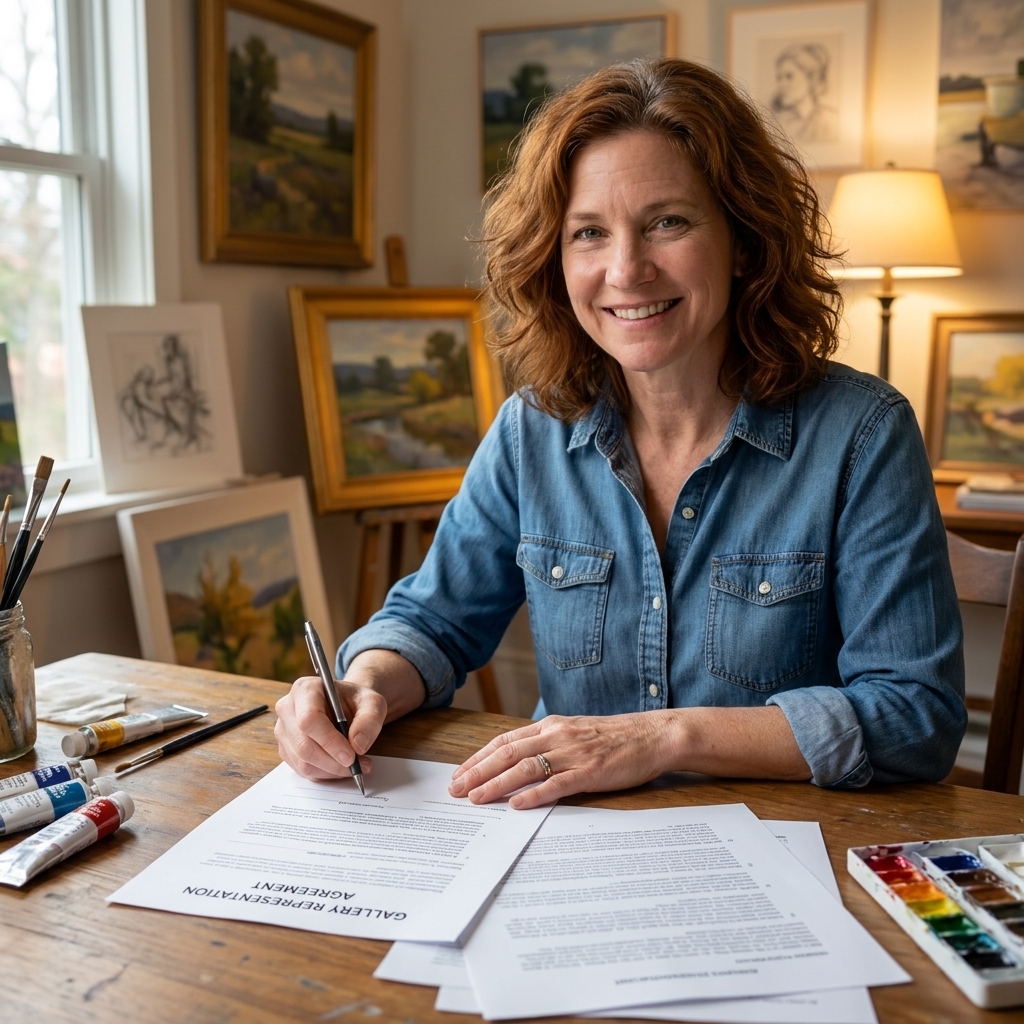
Submitting a portfolio to a fine art gallery can feel like trying to slip a note into the pocket of someone wearing museum-grade gloves. You want to be seen, but you do not want to leave fingerprints on the glass.
Here is the truth from the curator side of the desk: many galleries are open to discovering new artists. Some, however, do not review unsolicited submissions at all. What most galleries do share is a low tolerance for confusion, clutter, and submissions that ignore how their program works. The good news is that professionalism in this context is mostly about clarity, consistency, and respect for time.
Before you submit: pick the right galleries
The most elegant portfolio in the world will land flat if it is submitted to the wrong room. “Right” does not mean “most famous.” It means your work makes sense next to what they already champion, and your career stage aligns with what they can realistically support.
Match the program, not the vibe
Look at the last 12 to 24 months of exhibitions. Ask:
- Medium fit: Do they regularly show your medium, or are you the outlier?
- Scale fit: Do they sell work at your size and price range?
- Concept fit: Are they investing in artists with similar questions, not similar colors?
- Career fit: Are they launching emerging artists, or building longer museum trajectories for mid-career names?
Do a quick submission reality check
- Do they have submission guidelines on their website? Follow them exactly.
- Do they only accept artists via referrals or invitations? If so, do not force it. Build a pathway.
- Do they use a submission portal or website form? Use it. Paste the same clean materials there and keep formatting simple.
- Are they currently in an art fair season or installing a major show? Expect slower responses.
If you are unsure, start with a short list of 8 to 12 galleries you genuinely admire and could imagine working with for years. A gallery relationship is not a one-night stand. It is closer to a long rehearsal process, with trust notes along the way.
Curate your portfolio like a show
When I was curating, the submissions that stopped me were not the biggest. They were the most edited. A portfolio is not your archive. It is your strongest argument.
How many images?
Unless guidelines say otherwise, many galleries respond well to 10 to 20 images. Some want fewer, sometimes 5 to 10. Treat this as a starting point, then follow their instructions like a contract.
One body of work, or a clear pair
Galleries are building programs, not browsing talent shows. The most compelling portfolios present:
- One cohesive series that feels ready to hang together.
- Or two related series with a clear throughline, presented as “Series A” and “Series B,” not a shuffle.
Sequence matters
Open with something unmistakably you. Then build rhythm: a wide shot, a quieter piece, a surprise, a deepening. End on a work that lingers. If you want a simple test, lay thumbnails out and ask: Would I walk through this show?
Photograph your work clearly
Curators can forgive a less-than-perfect photo. They cannot forgive a photo that makes the work illegible.
Basics that elevate everything
- Neutral light: Use indirect daylight when possible. Avoid mixed lighting that turns whites yellow and blacks green.
- Square-on framing: Keep the camera parallel to the artwork. No dramatic angles.
- True color: Edit lightly for accuracy, not drama. Your work should not look different on the gallery wall.
- Clean background: For 2D work, a plain wall. For objects, a simple sweep or uncluttered environment.
- Sharp focus: If it is soft, it reads as careless.
Include details with intent
One detail shot can be powerful if the texture, mark-making, or material choice is essential. Too many detail shots read like you are padding the deck.
For installation, show scale
If you work in space, include one image where the viewer can understand scale, plus a cleaner shot that focuses on composition. If people appear, it should be for scale, not as the main subject.
Format it for a curator’s inbox
Curators are reading on phones between installs, on laptops between meetings, and sometimes on a cracked iPad perched on a packing crate. Make it easy.
Your ideal submission package
- A short email with links and a quick image preview.
- A PDF portfolio with clean captions.
- An artist statement (about 150 to 300 words) that says what you do and why, in plain language.
- A CV (1 to 2 pages) focused on exhibitions, education, residencies, awards, and relevant press.
- A link to your website and, if relevant, Instagram.
If a gallery asks for a single link instead of a PDF, make a dedicated landing page on your site with the same sequence, captions, and a downloadable PDF option.
PDF specs that rarely get you in trouble
- Length: Often 10 to 20 pages for 10 to 20 images, but some galleries prefer fewer. Follow their guidance.
- File size: 5 to 15 MB if possible. If it must be larger, use a link.
- Dimensions: US Letter or A4, portrait orientation is easiest.
- Typography: Simple and readable. Your captions are not an art project.
- File name: FirstnameLastname_Portfolio_2026.pdf
Captions that do the job
Every image should have consistent information:
- Title
- Year
- Medium
- Dimensions (consider listing both inches and cm)
- Edition (if applicable)
- Price (optional unless requested)
If you are unsure about including prices, it is acceptable to write: Prices available upon request. Some galleries prefer to discuss pricing after gauging fit.
Link hygiene
- Use one clean link when possible, not five different folders.
- If you use Google Drive or Dropbox, check permissions and test the link in an incognito window.
- Keep on-screen images in a web-friendly format and color space. sRGB is a safe default for screen viewing.
And unless a gallery requests it, do not mail original physical portfolios or prints. Unrequested packages often cannot be returned.
Write the email that gets read
Most submission emails fail for one reason: they try to do too much. Your goal is not to explain your entire practice. Your goal is to earn a click.
Subject line options
- Artist submission: Firstname Lastname, painting
- Portfolio submission: Firstname Lastname (Series Name)
- Submission for consideration: Firstname Lastname
A simple email template
Greeting
Dear [Name] or Hello [Gallery Team],
One sentence of fit
I am a [city]-based [medium] artist, and I am reaching out because I admire how your program champions [specific element], especially in [artist/show name].
Two sentences about the work
My current series, [series name], explores [plain-language theme] through [materials/process]. The work is [scale/format], and I am currently looking for gallery representation / exhibition opportunities in [timeframe].
Clear links
Portfolio (PDF): [link]
Website: [link]
Instagram (optional): [link]
Soft close
Thank you for your time and consideration. I would be glad to share additional images or studio views if helpful.
Warmly,
[Name]
[City]
[Phone optional]
[Website]
Personalization that feels real
One specific reference is enough. Mention a show they mounted, a talk they hosted, a text they published, or an artist whose presentation you genuinely responded to. If you cannot name anything specific, you are probably not ready to submit to that gallery yet.
Etiquette: timing and follow-up
Galleries run on overlapping calendars: exhibitions, fairs, shipping deadlines, collector meetings, studio visits, and administrative work that nobody sees. Your job is to be politely persistent without becoming background noise.
When to submit
- Good windows: after a show opens, or shortly after it closes.
- Trickier windows: the week before major fairs, holiday weeks, or during install days.
When to follow up
Unless guidelines say otherwise, a reasonable range is 10 to 21 days for a gentle follow-up. Smaller teams may need longer. If they specify timelines, trust those over any general rule.
A follow-up email that keeps dignity intact
Reply to your original email thread and write:
Hello [Name], I wanted to briefly follow up on my portfolio submission below in case it was buried. I would be grateful for any thoughts when you have a moment. Thank you again for your time. Warmly, [Name]
How many follow-ups?
Generally, two, spaced out, is a sensible ceiling. After that, let it rest and focus on building a new point of entry: a group show, a studio visit through a mutual contact, a conversation at an opening.
What galleries look for
Every gallery has its own taste, but the underlying questions are surprisingly consistent.
- Consistency: Can you deliver a body of work, not just a single hit?
- Clarity: Do we understand what we are looking at without a thesis defense?
- Craft: Is the work resolved in its own language?
- Professionalism: Do you communicate clearly, meet deadlines, and present information cleanly?
- Trajectory: Is there a sense of where the work could go next?
- Market reality: Can we place this work with our collectors without making up a story?
Notice what is not on that list: being trendy, sounding academic, or having the most followers. Those things can help, but they rarely replace the basics.
Red flags that tank submissions
- Mass emails where the gallery name is wrong, missing, or obviously pasted.
- Huge attachments that clog inboxes, especially uncompressed image files.
- No captions or inconsistent details, which signals disorganization.
- Overlong statements that read like a grant application.
- Pushy language like “I need representation urgently” or “Please confirm receipt.”
- Unclear availability or vague claims about sales and collections that cannot be verified.
If you recognize yourself in any of these, do not panic. Fixing them is not about playing a game. It is about making your work easier to advocate for once it is in the room.
If you do not have representation yet
Sometimes “no response” is not “no.” It is “not yet,” or “not through this door.” Here are curator-friendly ways to create context around your practice.
Build credible group context
- Juried exhibitions with strong jurors
- Artist-run spaces with thoughtful programming
- Small institutions or local museums with community exhibitions
- Residencies with public-facing outcomes
Be present in the ecosystem
Go to openings. Talk to artists. Ask good questions. Become a familiar face without treating people like stepping stones. The art world is small, and it remembers warmth.
Request a studio visit
If you have a mutual connection, ask for an introduction. If you do not, keep it light: a short email with 6 small images embedded and an invitation. Some curators prefer to see work in person only after a portfolio review, so read the room.

FAQ
Should I send JPEGs or a PDF?
If guidelines do not specify, send a PDF and include 3 to 6 small embedded images in the email body for quick viewing. Use a link for high-res files.
Is it okay to DM a gallery on Instagram?
For a quick question, sometimes. For a portfolio submission, it is rarely ideal unless the gallery explicitly invites DMs. Treat Instagram as a way to stay on their radar, not as your primary submission channel.
Do I need an artist statement?
In most fine art contexts, yes. Keep it short, specific, and human. If your statement reads like it could belong to anyone, it is not doing its job.
Should I include prices?
If requested, yes. If not, it depends. If your pricing is consistent and you are ready to sell, including a price list can help. If you are still calibrating, “Prices available upon request” is acceptable.
What about exclusivity and submitting widely?
Norms vary. In general, it is fine to submit broadly. If you are in active talks about exclusive regional representation, or a gallery explicitly requests exclusivity for a period of consideration, avoid submitting the same body of work to direct competitors in that region. If asked, be honest and keep it simple.
A final note from the curator side
A strong submission is an act of care. It says: I respect my own work enough to present it clearly, and I respect your time enough to make it easy to see.
If you do that, you are already ahead of the pile. And if the answer is not yes today, you have still built a bridge that can hold weight later.