Contemporary art has a funny habit of making smart people feel tongue-tied. You walk into a gallery, face a pile of bricks or a video of someone slowly peeling an orange for twelve minutes, and your brain goes: Am I supposed to get this?
Here is the secret I learned as a curator and dramaturg: you are not being tested. You are being invited. Critique is simply the craft of paying attention, then explaining what that attention reveals.
This guide gives you a repeatable way to do it, whether you are looking at a painting, an installation, a poster design, or a performance-based piece documented on a screen.
What critique is and is not
A critique is a structured response to an artwork. It balances what you see with what it does, and it makes room for why it might exist in the first place.
Critique is not a verdict
You do not need to decide whether something is “good” in the universal sense. A stronger question is: Was it effective on its own terms? Even “I hated it” can become a thoughtful critique if you can articulate what choices produced that reaction and what those choices communicate.
Critique is not decoding a secret message
Some works are rich with symbolism. Others are blunt instruments. Many are simply questions in material form. You can stay with uncertainty while you gather evidence.
Think of critique less like solving a riddle and more like describing weather. You are noticing conditions, patterns, and pressure systems.
Three lenses to try
When beginners feel stuck, it is usually because they are trying to use only one lens. Contemporary art often asks to be seen through multiple angles at once.
- Formal lens: What are the visual ingredients and how are they arranged?
- Conceptual lens: What idea is being staged, tested, or provoked?
- Contextual lens: Who made it, when, where, for whom, and in response to what?
You do not need all three every time, but if one lens fails you, switch to another. If the concept feels slippery, go back to form. If the form feels minimal, ask what the context is doing.
A method you can reuse
I like a simple six-step arc. It works in museums, on Instagram, at a poster show, or in a design critique at school.
Step 1: Take inventory
Start with description. Pretend you are writing for someone who cannot see the work.
- What is it made of? Paint, vinyl, found objects, type, light, sound, fabric?
- What is the scale? Handheld, room-sized, billboard-sized?
- What do you literally see or hear? Shapes, figures, a voiceover, a slogan, an empty pedestal?
- What is the condition? Polished, fragile, messy, worn, industrial?
This step protects you from the most common critique trap: projecting a meaning you have not earned yet.
Step 2: Notice your body
Your reaction is data, not a confession. Contemporary art can be engineered to hit you physically first, especially installation, sound, and performance work.
- Where do your eyes go first and why?
- Do you feel calm, irritated, curious, bored, tender, embarrassed?
- Do you want to step closer, step back, circle it, leave?
Write down two adjectives for the mood, then look for the choices that created them.
Step 3: Do a formal read
This is where you talk about composition and design decisions without getting lost in theory.
- Color: saturated or muted, warm or cool, harmonious or clashing
- Value and contrast: bright against dark, low contrast haze, sharp edges
- Line and shape: geometric, gestural, repetitive, fractured
- Space: flat, deep, crowded, empty, claustrophobic
- Material qualities: glossy, matte, rough, translucent, heavy, disposable
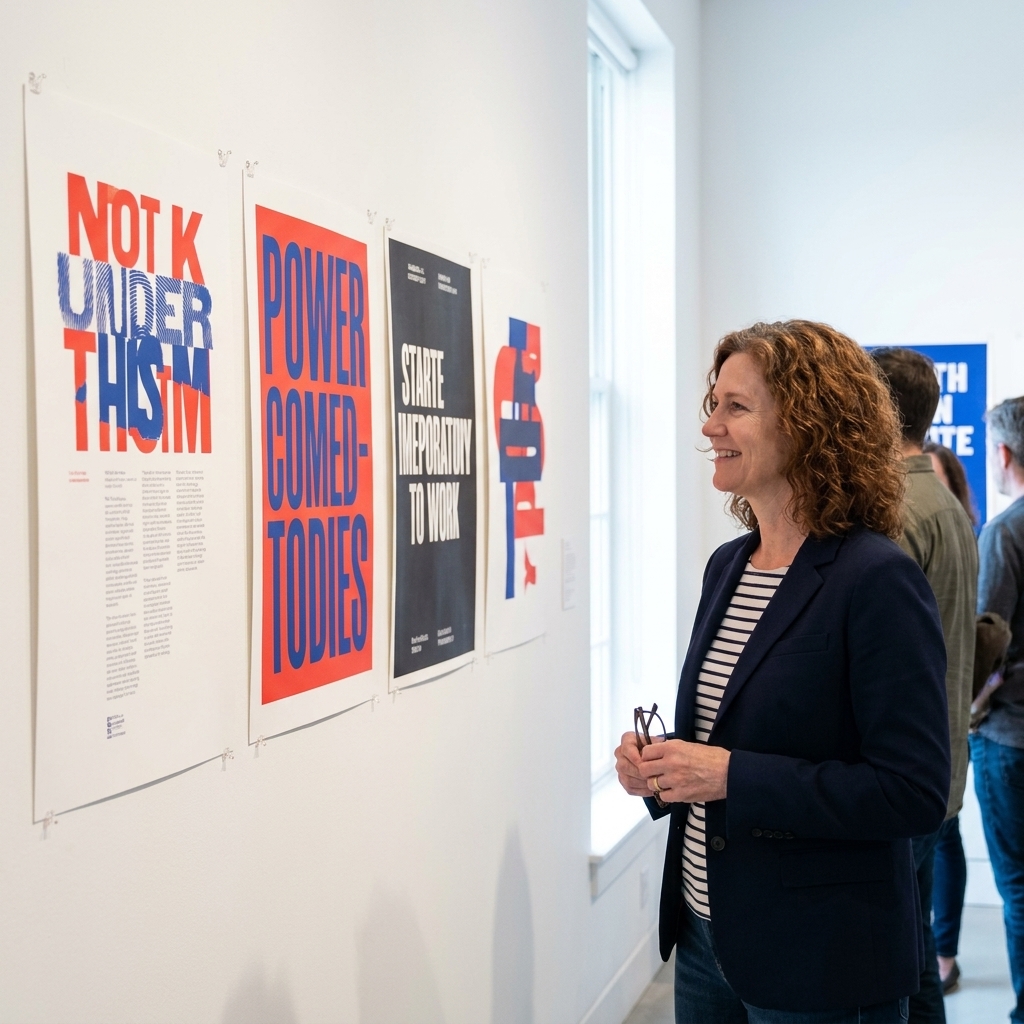
- Typography (for visual design): weight, spacing, hierarchy, legibility, tone
Step 4: Name the engine
Many contemporary pieces are built around a central tension. I sometimes call it the work’s “problem,” but you can also call it its engine, stakes, or friction. Try finishing this sentence:
This work seems to be asking what happens when…
- …an everyday object is treated like a relic
- …a private experience is displayed publicly
- …beauty is made uncomfortable
- …design borrows from advertising to critique advertising
If you cannot find the engine, look for resistance: where does the work refuse easy consumption?
Step 5: Add context carefully
Context is not trivia. It is oxygen. You can pull it from a wall label, an artist statement, a catalog essay, or reliable interviews. The goal is not to quote a thesis, but to answer a few grounding questions.
- What moment is this responding to: social media, migration, climate grief, surveillance, labor?
- What medium history is it in conversation with: painting, conceptual art, performance, graphic design, craft?
- Where is it shown and who is the audience?
A small ethics note: distinguish what you observe from what you learned from a source. Wall text and press releases are useful, but they are not neutral. If a claim matters, name where it came from, and treat it as context rather than proof.
One note from the curator side: it is perfectly fair to critique the institution too. A work about anti-capitalism inside a luxury fair has a built-in contradiction worth naming.
Step 6: Make a claim with evidence
This is the heart of critique: a clear statement plus specific proof from the work.
Try this structure:
- Claim: What the work achieves (or fails to achieve)
- Because: The choices that make that happen
- So what: Why it matters, what it leaves you thinking about
Example: “The installation turns the gallery into a waiting room, because the lighting is clinical and the sound loop is monotonous, so the viewer feels the slow violence of bureaucracy.”
Mini critiques
If you want to see the steps in motion, here are two quick worked examples. They are deliberately generic so you can adapt them to whatever you are actually viewing.
Example 1: Object-based installation
Inventory: A grid of thirty identical, dented metal lunch trays mounted on the wall. Each tray holds a small mound of soil and a single plastic fork. A harsh, cool spotlight creates sharp shadows.
Body: I feel a small jolt of discomfort. It reads like a memorial, but it also reads like a cafeteria line. My eyes keep counting.
Formal: The repetition creates rhythm and insistence. The industrial sheen of the trays clashes with the soft, absorbent dirt. The plastic forks look cheap, almost insulting, against the careful arrangement.
Engine: This work seems to be asking what happens when nourishment becomes administration, and when care is reduced to units.
Context (lightly): If the label mentions institutional food systems, labor, prisons, schools, or migration, it sharpens the reading. If it does not, the work still communicates through material contrast and repetition.
Claim: The piece makes scarcity feel organized rather than accidental, because its grid is orderly while its contents are bleak, so it turns a familiar object into evidence.
Example 2: Time-based video
Inventory: A seven-minute loop: a fixed shot of a person’s hands folding and unfolding a letter. The audio is mostly room tone, with occasional street noise. Subtitles appear, but they only transcribe breaths and pauses.
Body: I become unusually aware of my own breathing. I want the person to speak, then I start to suspect the silence is the point.
Formal: The framing is tight and repetitive. The loop structure makes the gesture feel like a ritual. The subtitles, instead of adding clarity, heighten absence by naming what is not said.
Engine: This work seems to be asking what happens when language fails, or when speech is unsafe, and the body has to carry meaning instead.
Context (lightly): If the wall text references censorship, grief, or displacement, it becomes a key. If it does not, the work still stages the viewer’s desire to “extract” a statement, then refuses to satisfy it.
Claim: The video turns silence into content, because it choreographs waiting through looping and captioning, so the viewer experiences the pressure to interpret without being given the relief of explanation.
Key context
Contemporary art is not a single style. It is often defined as a time frame and, loosely, a set of attitudes about what art can be. A few historical threads show up constantly, and knowing them makes critique easier.
From modernism to expanded definitions
Early modernists pushed form: flattening space, breaking perspective, experimenting with abstraction. Across the early 20th century and beyond, artists also began pushing the definition of art itself. Think of Marcel Duchamp’s readymades from the 1910s, which used a mass-produced object placed in an art context. That gesture still echoes every time you see a “regular” thing elevated to sculpture.
Conceptual art
In conceptual approaches, the point is not always what you see, but what the work sets in motion. Documentation, instructions, or ephemeral actions can be the artwork. When critiquing conceptual pieces, focus on clarity of premise and the viewer’s experience of the idea.
Postmodernism
Appropriation, remix, irony, and quotation enter the room. Artists sample popular culture, advertising, and art history, sometimes lovingly and sometimes like a scalpel. Critique here benefits from asking: Is the borrowing critical, celebratory, exploitative, or all three?
Design and art overlap
Contemporary visual design often speaks the same language as contemporary art: attention economies, persuasion, identity, power. If you are critiquing a design piece, you can still use the same steps, then add: Who is the client, what is the intended action, and what values are embedded in the aesthetic?
Vocabulary that helps
You do not need a glossary the size of a museum catalog. You need a handful of sturdy words that name what you are actually seeing.
What it is made of
- Medium: the materials and methods used
- Support: what the work is on, like canvas, paper, wall, screen
- Assemblage: a work built from combined objects
- Readymade: an everyday object presented as art
How it is arranged
- Composition: overall arrangement of elements
- Hierarchy: what the work makes you notice first, second, third
- Negative space: the “quiet” areas that shape the whole
- Rhythm: repetition that creates movement for the eye
What it is doing
- Interrogates: examines with pressure, not just references
- Complicates: refuses a simple takeaway
- Subverts: flips an expectation or power dynamic
- Invites participation: requires viewer action to complete the work
- Stages: sets up a situation to be experienced
A small craft note: verbs carry critique. Nouns can get you stuck. “This work interrogates visibility” is more helpful than “This work is about visibility.”
Critiquing visual design
Design critique shares DNA with art critique, but the stakes often include usability, persuasion, and audience clarity. Use the same six steps, then add these checkpoints.
Purpose and audience
- What is the job of the piece: inform, sell, recruit, protest, commemorate?
- Who is it speaking to and who might it exclude?
- Where does it live: subway poster, phone screen, gallery wall, packaging?
Legibility and ethics
- Can you read it at the distance or speed it is meant to be seen?
- Does the aesthetic borrow from a culture or community, and if so, is it respectful and specific?
- What does it normalize: beauty standards, surveillance, consumption, gender roles?
Brand voice
Consistency can be a virtue or a trap. A design system can make communication clear, but it can also smooth away urgency. A great critique notices when the polish serves the message and when it neutralizes it.
Common pitfalls
“My kid could do that”
Maybe. But could your kid do it here, with this timing, with this framing, with this history attached, and make it land? Skill in contemporary art is often about choosing constraints, controlling attention, and shaping meaning, not only rendering realism.
Obscurity as depth
Not every cryptic work is profound. Part of critique is naming when a piece feels undercooked, reliant on vague statements, or supported by a wall text that does all the heavy lifting.
Leaning too hard on statements
Statements can be helpful, but they are not the artwork. If the work and the statement disagree, that tension is worth discussing.
Forgetting pleasure
Yes, critique can address politics and theory. But do not skip the sensual part. How does the paint sit on the surface? How does the light change as you move? What does the sound do to your breathing? Pleasure is not shallow. It is information.
A 10-minute critique
If you want a practical template, try this three-paragraph structure right after you see the work.
Paragraph 1: Description and first response
What it is, what it looks like, and how it hit you in the first thirty seconds.
Paragraph 2: Evidence and choices
Name two or three formal decisions, then connect them to your experience. Be specific: color temperature, scale, pacing, material qualities, typography, placement.
Paragraph 3: Meaning and stakes
What question does it raise? What does it challenge or reveal? Who might read it differently and why?
If you want to level up, end with one honest sentence that keeps the conversation open, like: “I am not sure the piece resolves its own contradiction, but I cannot stop thinking about the way it turns looking into waiting.”
Writing a longer review
If you are aiming beyond a short critique, a longer review can still be simple. Think in five parts.
- Lede: One clear sentence about what you saw and what it felt like to encounter.
- Description: The concrete facts of what is present.
- Analysis: How the formal choices produce the experience.
- Context: The most relevant background, cited plainly.
- Evaluation: A claim about effectiveness, stakes, and what the work does to your thinking.
Keep your strongest observations up top, and let context support them rather than replace them.
FAQ
Do I need art history to critique contemporary art?
No. You need attention, patience, and a willingness to support your opinions with what is actually present in the work. Art history helps you add context and recognize references, but it is not the entry ticket.
What if I do not like the work?
Disliking is allowed. The critique question becomes: what did the work do that produced that dislike, and was that effect intentional, careless, or generative?
How long should I spend with a piece?
Longer than your first instinct, shorter than your guilt. Try giving it at least two full minutes of quiet looking. For time-based work, watch enough to understand the structure: the loop, the pacing, the shift.
Interpretation vs projection?
Interpretation is anchored in evidence from the artwork. Projection is when meaning arrives without support. A good critique shows its receipts: a repeated image, a material choice, a compositional emphasis, a title, a pattern of decisions.
A final permission slip
If contemporary art has ever made you feel shut out, I want to gently hand you a key: you can respond before you understand. Understanding often arrives through the act of describing, noticing, and asking better questions.
Critique is not about being right. It is about being awake in front of a work that someone made, in this strange shared moment we call culture.