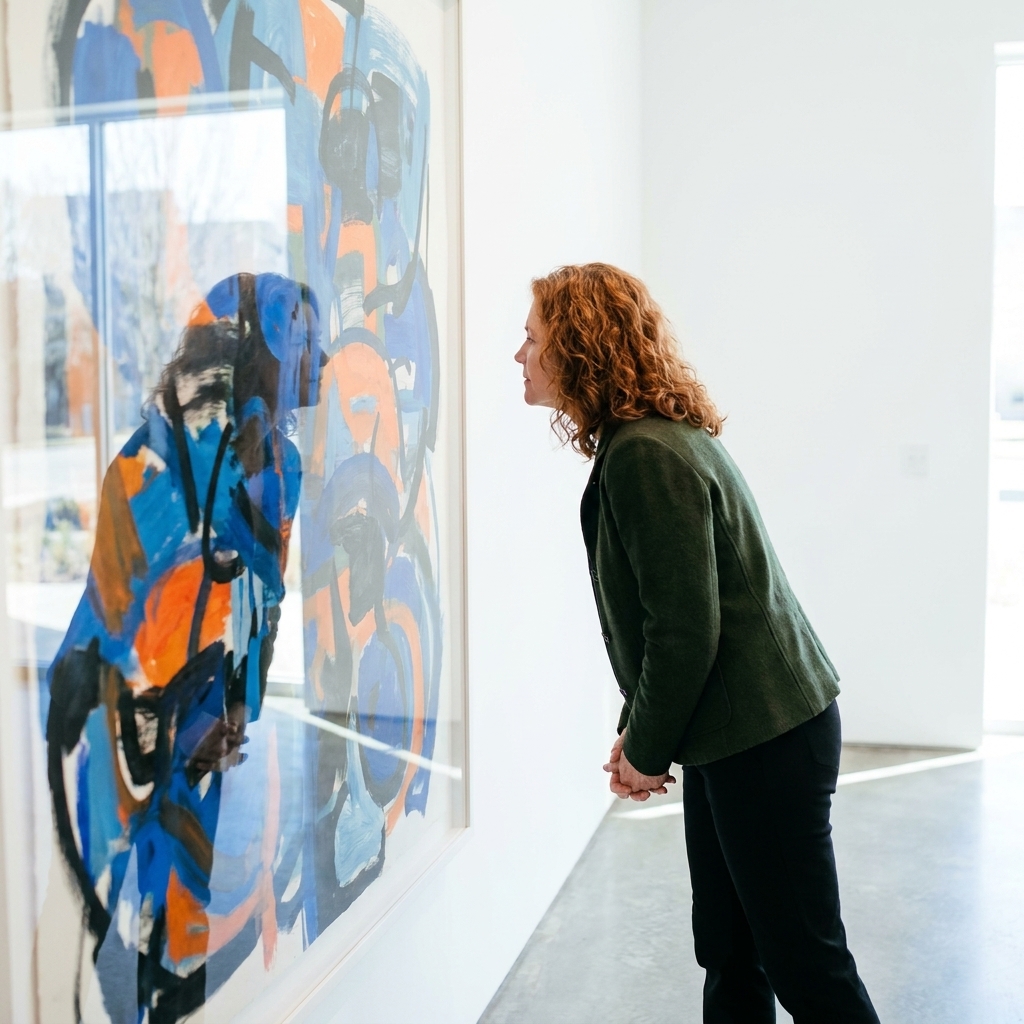
Not long ago, the most futuristic thing in a gallery was a pair of headphones and a wall label that begged you not to touch. Now, the “painting” might breathe back. The “room” might be a headset. The “artist” might be a person, a team, a model, or a conversation between all three. And the critic, traditionally armed with close looking and a well-tuned sense of context, has to ask a surprisingly basic question: what, exactly, am I reviewing?
Immersive tech has not simply added new mediums to the art world. It has stretched the boundaries of what we mean by visual design, authorship, craft, and even spectatorship. Artificial intelligence and virtual reality are forcing criticism to expand its toolkit, not to keep up with novelty, but to remain honest about how these works function in our bodies, our browsers, and our shared culture.
When the frame disappears
Traditional criticism has a comfortable geometry. A painting stays put. A sculpture holds its ground. Even a video loop, for all its time-based mischief, can be described as an object you approach, watch, and leave.
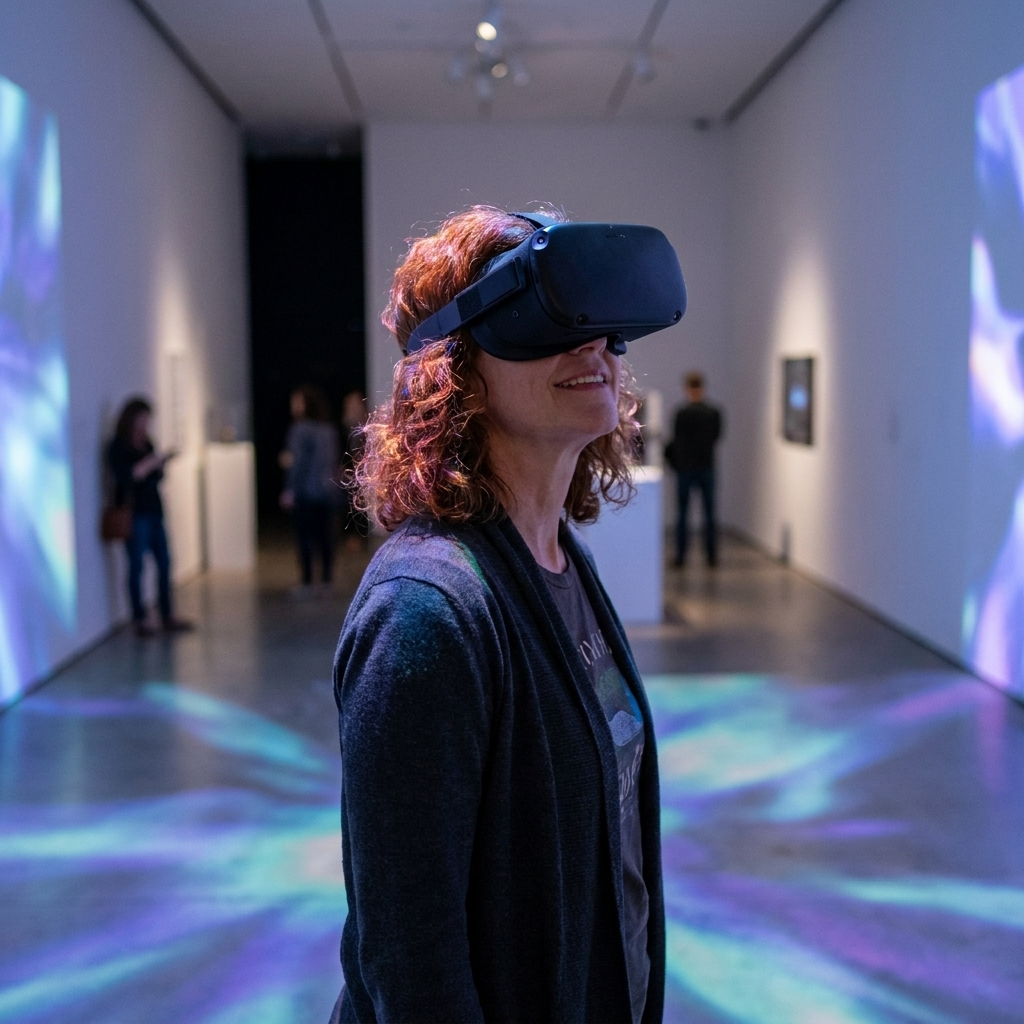
VR dissolves that geometry. The frame is no longer a boundary around an image. It is a boundary around you. In a headset, the work is not “over there.” It is everywhere your head turns, and, in many contemporary pieces, it responds to what you do. That matters because the critic is no longer describing only composition, palette, or iconography. They are describing experience design, the choreography of attention.
Criticism becomes spatial
If you have ever watched audiences in a good theater piece, you know the story is partly written in their bodies. VR makes that visible. Some works coax you to move slowly, as if you are in a chapel. Others nudge you into game-like scanning, hunting for triggers and hidden doors. A critic now has to account for:
- Orientation: Where does the work want your gaze to land first, and why?
- Navigation: Are you invited to wander, guided on rails, or subtly herded?
- Scale: Does the world dwarf you, flatter you, or distort you?
- Presence: Do you feel alone, watched, accompanied, implicated?
These are not “tech issues.” They are aesthetic issues. They are the new equivalents of brushwork, lighting, and placement, only translated into space and sensation.
AI makes style easy, meaning costly
AI image generation has made a curious thing happen: the surface of an image can arrive astonishingly fast, while the question of why it exists can feel more urgent than ever.
For decades, critics could lean on a set of reliable assumptions. The look of a work was tethered to a maker’s hand, training, limitations, and time. Today, with mainstream generators, an artist can draft dozens of variations of a scene in an afternoon, each in a different “style,” each polished enough to pass at a glance in certain contexts. At the same time, anyone who has tried to make an AI image truly behave knows the counter-truth: consistent characters, controllable details, and print-ready results often still require substantial craft, iteration, and restraint.
So the critic cannot stop at “it’s beautifully rendered.” That sentence no longer tells us much.
From virtuosity to choices
In AI-assisted work, the locus of craft often shifts from manual execution to a chain of decisions. Critics are starting to read:
- Dataset gravity: What visual histories pull the image into familiar stereotypes or overused aesthetics?
- Constraint as signature: What rules did the artist impose to resist generic output?
- Iteration as process: Which versions were discarded, and what does the final selection privilege?
- Disclosure and ethics: Is the sourcing of training material acknowledged, licensed, contested, or obscured?
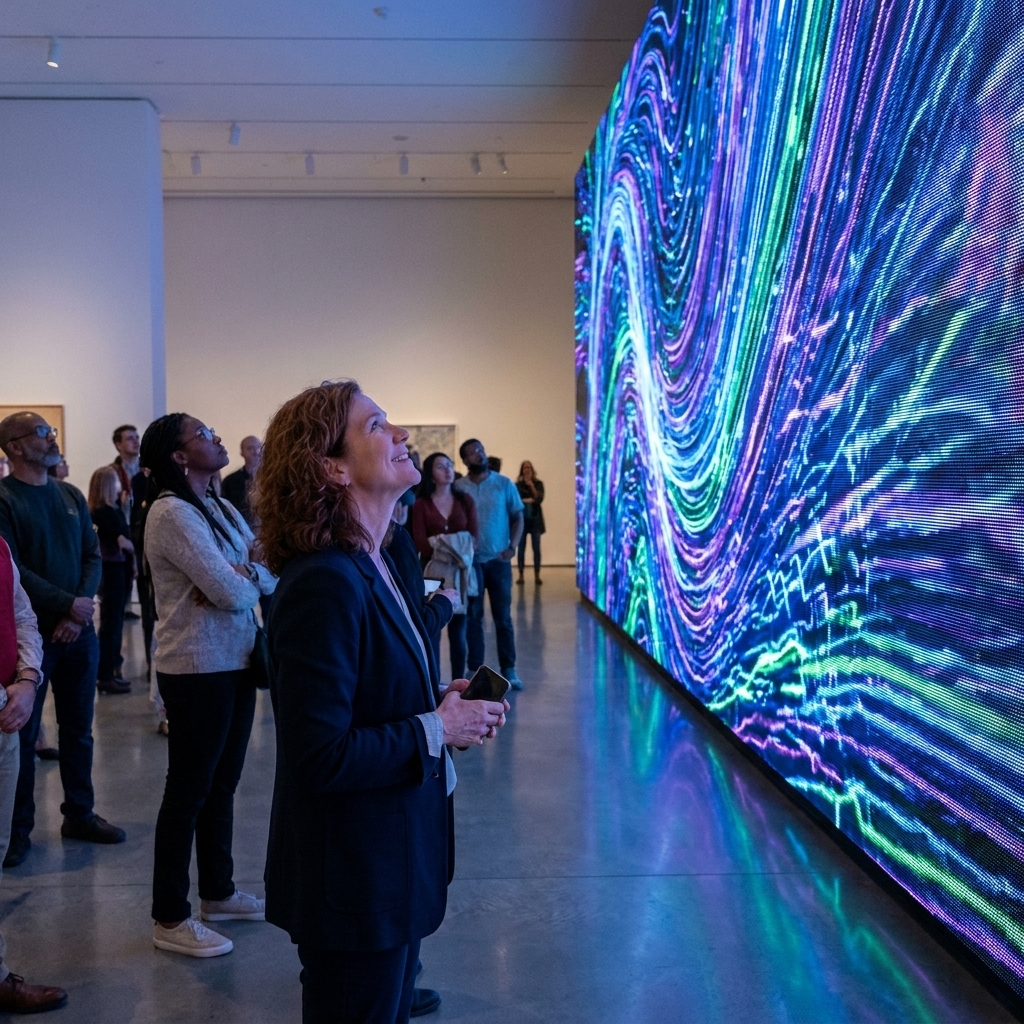
There is a paradox here that I find oddly hopeful. When “style” becomes easy to summon, intention becomes the real medium. Critics end up writing less about polish and more about purpose, tension, and consequence. You can see this clearly in data-driven spectacle works such as Refik Anadol’s large-scale installations, where the argument is not just in the visuals, but in what is being captured, computed, and framed as wonder.
What is the work now
One of the quiet revolutions of immersive tech is that it turns artworks into systems. A VR piece might depend on hardware, room-scale tracking, software updates, and platform policies. An AI-driven installation might produce different outputs every day, reacting to a live feed such as weather or audience movement. Rafael Lozano-Hemmer’s interactive pieces, for instance, have long made the audience a literal input, reminding us that “the work” can be a loop between bodies and a machine.
Criticism, then, has to decide what it treats as the work.
Where critics draw lines
- The artifact line: Is the artwork the final image, the code, the prompt, or the whole pipeline?
- The time line: Is a piece defined by its premiere version, or by its evolving updates?
- The platform line: Does the work change when it moves from museum to headset to phone?
- The audience line: If viewers materially shape the outcome, how do we write about “the” piece?
In performance, we already accept that a work can be re-staged, interpreted, and altered by conditions. Immersive visual art borrows that logic. Critics are increasingly writing about versions and runs, not only about singular objects.
Embodiment matters
I spent years in black-box theaters where you can tell, within five minutes, whether the audience is leaning forward or checking out. VR does something similar, except the audience’s sensorimotor system is on the line. Motion sickness, vertigo, delight, claustrophobia, comfort. These responses are not side effects. They are part of the work’s aesthetic contract.
Accessibility is not a footnote
Immersive design asks critics to take accessibility seriously as a primary lens. Not in a scolding way, but in an honest one: if a piece requires a particular body or a particular tolerance for disorientation, that shapes its meaning and its reach.
- Physical access: Can the work be experienced seated? Does it assume full mobility?
- Sensory load: Are there strobe-like effects, intense audio, or crowded visual fields?
- Economic access: Is the “public” version locked behind costly hardware or subscriptions?
- Language and UI: Are controls intuitive, or do they gatekeep the experience?
In the old model, a critic could imply a universal viewer. Immersive art makes that fantasy harder to maintain, and that is a healthy correction.
Authenticity after aura
Walter Benjamin’s famous “aura” has been argued over for so long it has practically earned its own museum pass. But immersive tech gives the aura debate new texture. A VR work can be “original” in the sense that it is designed, authored, and composed. Yet it can also be duplicated and distributed with relative ease, even if access is still shaped by platforms, hardware, licensing, and file sizes. You may be alone at home in sweatpants, but you are not outside the system that delivered the work to you.
Meanwhile, AI complicates authenticity in a different direction. If an image is generated, what is the “original” state? The prompt? The seed? The first output? The curated final? The model checkpoint? Authenticity becomes less about singularity and more about traceability.
What to look for instead
- Provenance of process: Can we follow how the work came into being?
- Integrity of presentation: Does the exhibition context clarify what we are seeing and how it was made?
- Risk and specificity: Does the work commit to a particular idea, or does it float on generalized beauty?
In other words, the “aura” may migrate from objecthood to accountability.
Documentation and versions
There is a practical problem critics do not always admit: immersive works are hard to revisit. A screenshot flattens a headset world into a rectangle. A screen recording captures motion but not presence. A write-up based on a festival build may not match the museum build six months later.
As a result, good criticism is starting to borrow habits from software, conservation, and performance studies. It helps to note what version you encountered, what hardware you used, and what conditions shaped the experience. Even a short line such as “reviewed on Quest 3, room-scale, build dated May 2026” can become a form of honesty, and a gift to future readers.
The critic’s toolkit
None of this means critics should trade their eyes for spec sheets. The best criticism still starts with close attention and a willingness to be moved. But immersive tech adds layers that are hard to ignore, and frankly, fun to learn.
Questions to bring with you
- What is the work asking me to do? Watch, wander, choose, collaborate, obey, resist?
- Where is the authorial voice? In the imagery, the rules, the interaction design, the curation of outputs?
- What does the technology amplify? Intimacy, spectacle, surveillance, speed, empathy?
- What does it obscure? Labor, sources, bias, energy and compute costs, platform dependency?
- How does it end? Do you exit changed, or simply ejected?
And yes, sometimes the right question is: Is this actually good, or is it merely impressive? That distinction has always mattered. It just matters more when “impressive” comes preloaded.
Where criticism lands
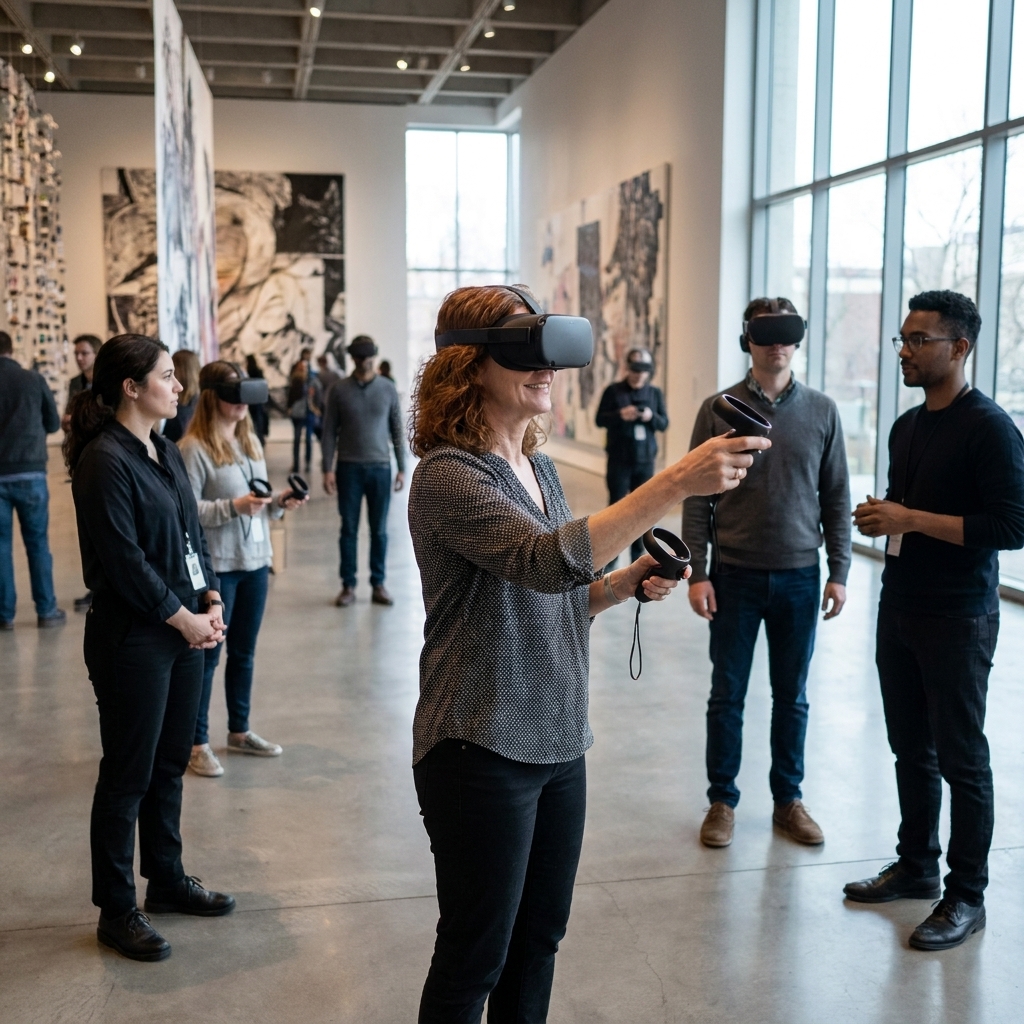
Design criticism has long lived in the borderlands between fine art, communication, and lived environment. Immersive tech pulls that borderland into the spotlight. The visual is no longer only something you look at. It is something that looks back, tracks, predicts, responds, and sometimes persuades.
That is why this moment feels less like a new “movement” and more like a new literacy. Critics are being asked to read not just images, but systems of seeing. To ask who is included, who is extracted from, and who gets to feel at home inside the digital frame.
If that sounds heavy, here is the gentler truth I keep returning to: people still want to be moved. Whether it is oil paint or volumetric light, we are still looking for the same human spark, that quiet click in the chest that says, “Someone made this, and it’s speaking to me.” The tools are changing. The job of criticism, at its best, stays beautifully consistent. It helps us listen.
Quick FAQ
Is AI-generated work real art?
It can be. “Real” is not the hurdle. The meaningful questions are about intention, accountability, and what the work is doing in the world. AI can be used to deepen an idea or to manufacture aesthetic noise. Critics are learning to tell the difference by looking at choices, context, and ethics, not just surface.
How do you critique VR if each viewer differs?
By describing the range the work allows and the structure underneath it. Think of it like reviewing a play with improvisation. You can still analyze themes, pacing, visual language, and how the piece guides attention, even if small details vary.
Do these tools replace traditional media?
In practice, they tend to sit alongside it. Many of the most interesting artists move between analog and digital, using each to expose different kinds of truth. The more useful question is: what kinds of experiences does each medium make possible?