Classical theater asks for something deliciously old-fashioned and surprisingly modern: clarity. Not just of text, but of intention. If you have ever watched a performer make a 600-seat house feel like a living room, you already know what stage presence really is. It is not volume for its own sake. It is a body that reads cleanly from the back row, a voice that lands without bruising your throat, and an attention to the audience that stays generous without fishing for approval. Keep the objective on your partner, your action, your thought. Let the audience come to you.
Below are the techniques I return to, whether I am sitting in a dark rehearsal room with a marked-up script or in the audience, quietly noting who makes the air change when they enter.
Projecting without strain
Projection is often taught like a dare: louder, louder, louder. Classical work punishes that approach. You can push for a week and then spend the rest of the run sounding like you have swallowed sand.
The goal is not force. The goal is carry. Think of your voice as a focused beam, not a floodlight.
1) Breath that moves the phrase
If your shoulders lift, your neck tightens. If your ribs and lower back widen, your sound has somewhere to live.
- Try this in two minutes: Stand with feet hip-width apart. Inhale silently through the nose and imagine your breath expanding your lower ribs sideways like an umbrella opening. Exhale on a long "sss" for 15 to 25 seconds. Repeat three times. Then speak one line, riding that same steady exhale.
- What you are looking for: the line feels supported, not shouted. Your jaw and tongue stay loose.
2) Consonants as handholds
In big rooms, vowels are gorgeous but consonants are the navigational system. Crisp consonants give the audience handholds, especially in verse.
- Practice: Choose a short passage and over-articulate only the consonants while keeping the volume moderate. Then dial articulation back by about 20 percent so it stays truthful, not cartoonish.
- Quick check: If the back row cannot understand your final consonants, they will miss your meaning, and you will start overcompensating with volume.
3) Forward resonance, not throat effort
When actors say, “Put it in the mask,” they are usually pointing to resonance sensations that feel forward, more in the face and head than clamped in the larynx. It is not “make it nasal.” It is “let the sound ring with less effort.” You may feel vibrations around the cheekbones and nose when resonance is working for you.
- Hum test: Hum on an “m” like you are agreeing with a friend. Keep the lips gently closed. Feel the buzz in the front of the face. Then open into a spoken line without letting the sensation collapse into the throat.
4) Let the room help you
Every auditorium has acoustic sweet spots. A hard back wall reflects sound. Heavy curtains can absorb and dampen sound, especially higher frequencies, though every space behaves a little differently. If you can, do a short sound check before rehearsal.
- What to do: Speak one line to the back wall, then to the balcony, then to the far corners. Notice where you instinctively tighten. The fix is rarely “more.” It is usually “cleaner.”
Space and readability
Classical performance is big not because it is fake, but because distance is real. You are communicating across space, light, and sometimes a complicated hat.
1) Enter with a verb
Presence begins before the first word. The audience decides whether to trust you in the first few seconds of your entrance.
- Technique: As you enter, pick a destination and a reason. “I cross to the table” is blocking. “I cross to claim the room” is playable. The body changes when the verb is active.
- Rehearsal note: Do your entrance three times without speaking, focusing only on intention and breath. Then add text.
2) Cheat out cleanly
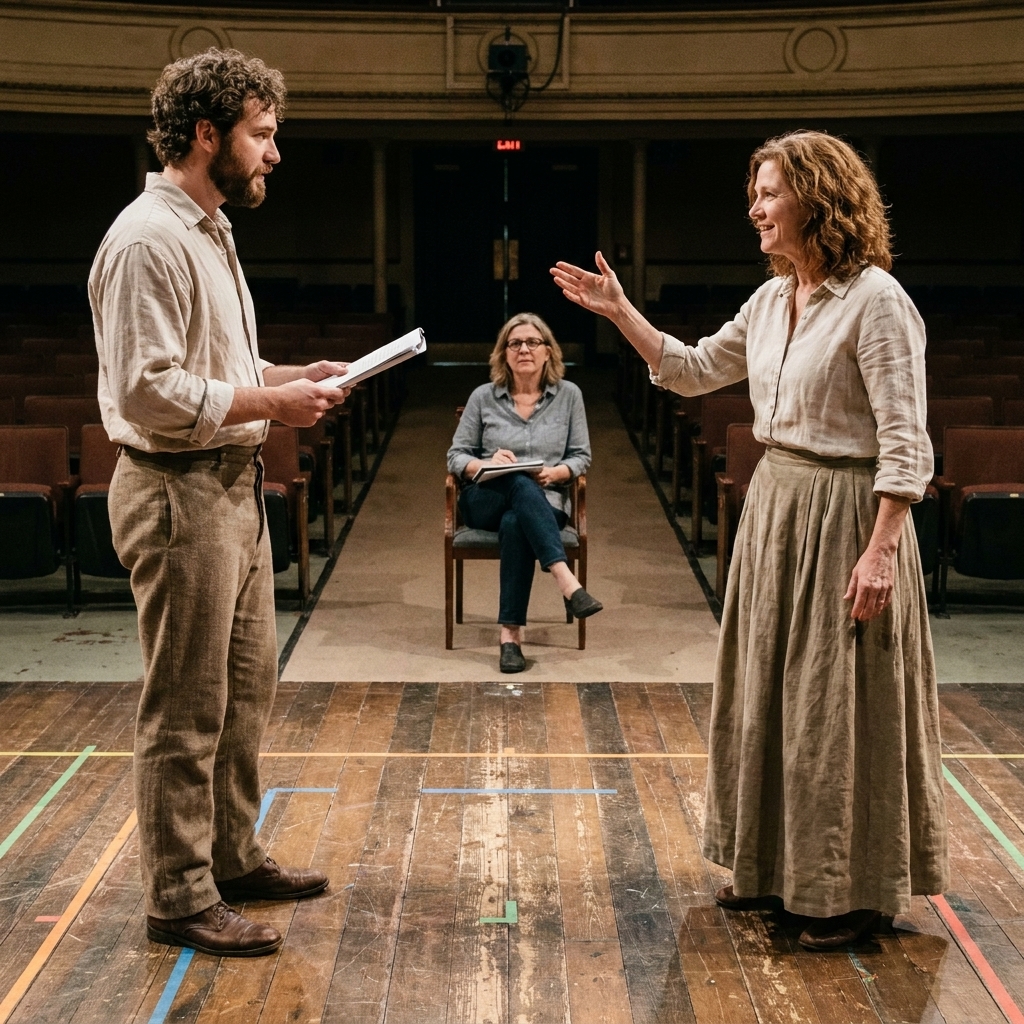
In classical staging, you often need to share your face with the audience even during an intimate exchange. The trick is to keep your focus on your scene partner while angling your body open.
- Simple rule: Keep your sternum available. If your chest is completely turned away, your sound and your story both disappear.
- Partner cue: Agree in rehearsal on shared sightlines so both of you stay visible rather than constantly blocking each other.
3) Levels and stillness
Movement reads as energy. Stillness can read as authority, listening, shock, or even loss of status, depending on the given circumstances. Neither is “better,” but they mean different things, and the audience will assign meaning fast.
- Try this: Mark one moment in a speech where you stop moving entirely. Let the thought land. Then move again only when the idea changes. Suddenly, your staging has grammar.
- Levels: Sitting, kneeling, stepping onto a platform, or simply shifting weight can reframe power without adding extra business.
4) Stage pictures
As a former curator, I cannot help seeing stage composition like a series of frames. Where is the visual focus? What shape are you making with other bodies?
- Quick audit: Freeze in key moments. Look from the house if possible. Are you creating accidental tangents? Are faces hidden? Are you upstaging the wrong beat?
- Useful mantra: If the audience cannot see you, they cannot feel you.
Holding the house
There is a special kind of classical charisma that feels like direct address even when you never technically speak to the audience. It is attention, not exhibitionism.
1) Play to the far listener
When nerves hit, you start performing for the person in the front row who looks unimpressed. Classical presence asks the opposite. Imagine your ideal listener is seated at the back, eager and intelligent. Your energy will travel outward.
- Exercise: Pick three targets: back center, balcony left, balcony right. In a monologue, let your focus shift between them on new thoughts, not randomly. This creates the feeling of a mind moving through ideas, and it keeps the whole house included.
2) Let thought lead sound
The audience does not fall in love with your voice. They fall in love with your thinking. In verse, especially, the temptation is to surf the rhythm and forget the argument.
- Technique: Paraphrase each line in plain language in the margins. Then speak the original text, carrying the paraphrase underneath like a quiet motor.
- Listening test: If you stop understanding what you are saying mid-speech, the audience left five words ago.
3) Rhetoric as stagecraft
Classical texts come pre-loaded with tools for connection: antithesis, repetition, lists, questions. These are not decoration. They are invitations to follow you.
- Make it playable: Circle rhetorical questions. Decide who you are asking. Mark repetitions and choose whether each repeat intensifies, softens, or shifts target.
- Rule of three: In lists, build. Do not keep everything on the same emotional shelf.
4) A quick text example
Take Antony’s famous list in Julius Caesar: “Friends, Romans, countrymen.” It is not three synonyms. It is a staircase.
- Friends: intimacy. Let it land close.
- Romans: civic identity. Broaden the address, include more of the room.
- Countrymen: belonging. Let it ring to the farthest seat, not by shouting, but by clarity and space.
The rhetorical device is doing stage management for you. Your job is to reveal it, not varnish it.
5) Room breathing
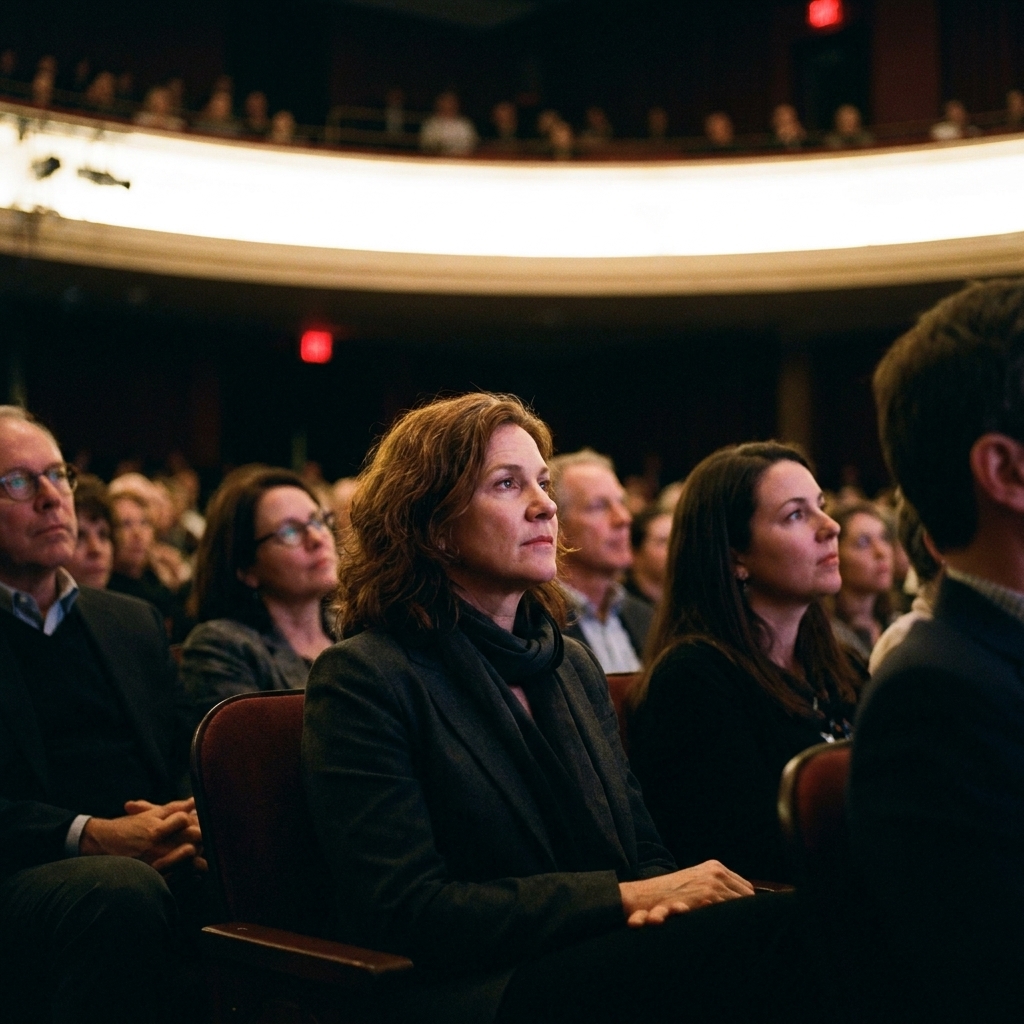
One of the most magical sensations in a theater is feeling an entire room inhale with you. You earn it by pacing: you allow space for meaning.
- Practice: After an important image or revelation, take a small, honest pause. Not a dramatic freeze. Just enough time for the thought to arrive in the seats.
- Watch for: If the pause feels dead, your intention is unclear. If it feels electric, you are sharing focus with the house.
Body basics
Stage presence is physical literacy. You are writing meaning with posture, weight, and rhythm.
1) Feet and ground
Wobbly feet create wobbly thoughts. In classical work, the text can be complex enough. Give yourself a stable base.
- Reset: Feel the tripod of the foot: heel, big toe mound, little toe mound. Let the knees unlock. Suddenly your breath gets easier.
- Character choice: A grounded stance can signal authority. A forward-leaning stance can signal urgency. Make it intentional.
2) Hands: do less
Fussy hands read as apology. Classical language already contains gesture. Your job is to select, not decorate.
- Rule: One clear gesture beats five half-gestures.
- Exercise: Run a speech with hands resting softly at your sides. Then add gestures only where they clarify action or image. Keep the rest clean.
3) Eyes and focus
“Seeing” is an action. When an actor truly sees, the audience leans in.
- Practice: Choose one moment to look directly at your partner’s eyes, one to look at a point just beyond them, and one to look into the distance of an idea. This creates variety without twitchy scanning.
Rehearsal habits
Presence is not a lucky charm you find on opening night. It is the result of repeatable habits.
1) Warm up every time
- Voice: 5 minutes of breath, 5 minutes of resonance, 5 minutes of articulation.
- Body: Gentle spinal rolls, hip opening, shoulder release. Your instrument is your whole self.
2) Beats and verbs
If you do not know what you are doing, your body fills the silence with random motion. Classical text rewards specificity.
- Write this in the margins: What do I want? What am I doing to get it? Who is my target? What changes?
- Presence payoff: Action reads. Confusion leaks.
3) Record from the back
You do not need fancy equipment. A phone placed in the last row can tell you the truth about clarity, pace, and whether your consonants are actually landing.
- Listen for: dropped endings, swallowed names, pace that accelerates on nerves, and moments where energy disappears on transitions.
4) Stamina over heroics
Classical roles are athletic. Your voice and body need endurance.
- One useful option: Run long speeches at about 80 percent effort in rehearsal to build consistency and keep your instrument fresh. Then, in a separate pass, practice performance intensity with efficiency, staying released and supported. The point is control, not bravado.
Troubleshooting
“I project, but I sound harsh.”
Harshness usually means throat effort. Back up to breath and resonance. Reduce volume and sharpen consonants. You will often read clearer at a lower decibel level.
“I disappear when I stop moving.”
Stillness only works if there is intention inside it. Give yourself an active thought, a target, and a breath. Stillness is not empty. It is concentrated.
“I rush the verse.”
Verse rushing is often fear of sounding artificial. Allow the line to breathe. Let the end of the line land, then move to the next thought. Clarity is kindness, but you only need to say it once.
“I feel like I am acting at the audience.”
Shift from performing to sharing. Choose an ideal listener and speak to them rather than at the room. Your energy can be generous without being needy.
20-minute tune-up
If you want something concrete, here is a 20-minute stage presence tune-up I love before a run-through.
- 3 minutes: Breath on “sss,” then one line on a supported exhale.
- 4 minutes: Humming into text, finding forward resonance.
- 4 minutes: Consonant clarity pass on a short passage.
- 4 minutes: Blocking check: cheat-out, sightlines, one clean stillness beat.
- 5 minutes: Full speech to three targets in the house, shifting focus on new thoughts.
Make a cup of tea afterward if you can. Not because it is magical, but because ritual tells your nervous system: we have done this before. We know how to fill a room.
Voice care note
A final, practical kindness to yourself: strain is not a badge. If something hurts, stop and reset. Hydrate, warm down gently after heavy work, and prioritize sleep when you can. If you are consistently hoarse, losing range, or feeling pain, check in with a qualified voice teacher, coach, or a medical professional such as an ENT or SLP. The goal is a voice you can rely on for the whole run, and for the rest of your life.